




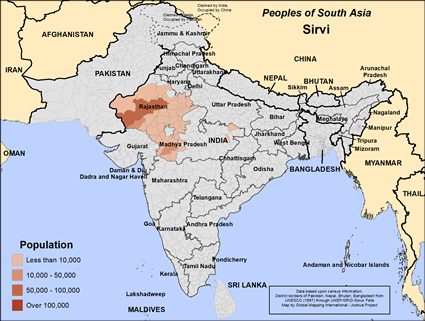
The Sirvi are a Hindu community found primarily in the Indian states of Rajasthan, Gujarat, Maharashtra, Madhya Pradesh, and Karnataka. Their primary language varies by region and may include Marwari, Rajasthani, Hindi, Gujarati, or local dialects. The name "Sirvi" is commonly understood to mean "partner," reflecting a historical association with cooperative farming and agricultural management. Community traditions trace their origins to Rajput warrior groups that migrated from parts of present-day Gujarat into Rajasthan during the medieval period. According to these traditions, after periods of warfare and political upheaval, many abandoned military life and turned to agriculture, eventually becoming known for their skill as cultivators and land managers.
Over the centuries, the Sirvi developed a strong reputation as an agricultural community. Their history is closely connected with the Marwar and Godwar regions of Rajasthan, where many families established villages and farming settlements. As economic opportunities expanded, Sirvi families migrated to other parts of India, entering business, trade, education, and professional occupations while maintaining strong community ties and cultural traditions.
Agriculture has traditionally been at the center of Sirvi life. Many families have been involved in farming, livestock management, and agricultural trade for generations. In modern India, while farming remains important, increasing numbers of Sirvi work in business, government service, education, engineering, healthcare, transportation, and other professions. Their reputation for hard work, entrepreneurship, and community cooperation has helped many families achieve economic stability.
Family relationships are highly valued, and extended family networks play an important role in social and economic life. Marriage is regarded as a significant family responsibility, and community organizations often help preserve traditions and strengthen social bonds. Education is increasingly emphasized, with many parents encouraging their children to pursue higher education and professional careers. Daily life typically revolves around work, family responsibilities, religious observance, and participation in community events.
Food customs vary by region but often reflect the cuisine of western India, including wheat-based breads, lentils, vegetables, dairy products, and traditional Rajasthani dishes. Religious festivals, weddings, and community gatherings provide opportunities to celebrate their heritage and reinforce family connections.
The Sirvi are predominantly Hindu. Their religious life includes temple worship, household rituals, observance of Hindu festivals, and devotion to various Hindu gods and goddesses. Many families maintain strong ties to regional traditions and community religious observances that have been passed down through generations.
Like many Hindu communities, the Sirvi generally believe in karma, rebirth, and the pursuit of spiritual merit through religious devotion, rituals, and good works. Worship may include offerings, fasting, pilgrimages, and participation in festival celebrations. Their spiritual worldview is shaped by Hindu scriptures, community traditions, and family customs.
Most Sirvi have had limited opportunity to hear a clear presentation of the biblical message that forgiveness of sins and reconciliation with God come through faith in Jesus Christ rather than through accumulated merit or religious observance. They live in Rajasthan, one of India's least reached states.
The Sirvi need greater access to the gospel through trusted relationships, Scripture in languages they readily understand, and faithful Christian witnesses who can clearly communicate biblical truth. Their strong cultural identity and deep connection to Hindu traditions can make meaningful gospel engagement challenging without long-term relationships built on trust and respect.
Practical needs vary according to region and economic circumstances. While many families have achieved stability through agriculture, business, and professional careers, others continue to face challenges related to employment opportunities, educational advancement, and rural development. Programs that strengthen families, improve educational opportunities, and support economic development can contribute positively to community well-being.
Above all, the Sirvi need opportunities to encounter Jesus Christ through God's word and through believers whose lives demonstrate His grace, truth, and transforming power.
Pray that the Sirvi would have opportunities to hear a clear presentation of the gospel and understand the saving work of Jesus Christ.
Pray that God would raise up faithful believers who can build genuine relationships among the Sirvi and share biblical truth with wisdom, humility, and love.
Pray that the Sirvi would be adopted through the People Group Adoption program so that churches and believers will commit to ongoing prayer, outreach, and future gospel engagement among them.
Pray that any existing believers who have connections with the Sirvi would be strengthened in their faith and equipped to reach their own community and neighboring peoples with the gospel.
Scripture Prayers for the Sirvi in India.
https://en.wikipedia.org/wiki/Sirvi
https://www.peoplegroups.org/explore/GroupDetails.aspx?peid=12206
https://www.seervisamaj.com/about.php
https://southasiacommons.net/artifacts/21019203/seervi-community/21919635/
| Profile Source: Joshua Project |



